Complete Guide to AC & HVAC Maintenance in Dubai: Costs, Performance & Best Practices
Average price for a routine tune-up of a single unit of AC in Dubai is AED 150 to AED 350, and for Annual Maintenance Contracts (AMC) for apartments and villas it is AED 800 to AED 3,500+. To prevent breakdowns during peak summer, combat indoor mold and sand contaminants, and reduce DEWA electricity consumption by up to 15%, the air conditioning system needs regular maintenance including cleaning the filter every 4 to 6 weeks, flushing the drain line, chemical coil washing, and checking the refrigerant.
Set thermostats to 24°C on “Auto” for maximum efficiency and 8-12 year equipment lifespan. The key point to note here is that in a standard Dubai Ejari contract, small repairs below AED 500 are the tenant’s problem, while larger repairs over AED 500 are the landlord’s problem.
In this comprehensive guide, we discuss maintenance schedules, direct service costs, HVAC differences, special care tips for high-density areas, and crucial steps every Dubai property owner and tenant should know about.
Table of Contents
Key Takeaways
- Standard Pricing: Routine single unit servicing AED 150 to AED 350, and for annual contracts (AMC) AED 800 to AED 3,500+ for apartments and villas.
- Service Frequency: Wash air filters every 4 to 6 weeks during the summer (8 to 12 weeks during the winter) to prevent buildup of desert sand and mold.
- DEWA Savings: Cleaning coils and setting thermostats to 24°C on “Auto” can reduce cooling energy consumption by up to 15%.
- Climate Requirements: Bi-yearly chemical cleaning of coils and duct sanitization due to extreme heat (45°C+) and coastal humidity.
- Lease Rules: The tenant is responsible for minor maintenance as per the standard Ejari terms (under AED 500); the landlord is responsible for major repairs over AED 500.
Why Is Regular AC Maintenance Vital for Dubai Properties?
Regular maintenance of your AC will prevent breakdown during the peak of summer, minimize high electricity bills and also enhance indoor air quality by clearing dust, airborne sand and microbial contaminants in the ductwork. Cooling systems in the UAE function almost non-stop, and frequent filter cleanings, coil inspections and chemical flushes protect components against premature mechanical degradation.
In the desert atmosphere, the evaporator and condenser coils get coated fast with dust and airborne particulate matter. Dirt blocks the flow of heat and the compressor has to work a lot more to reach thermostat settings. This leads to excessive wear and tear on internal wiring, bearings and blowers, which results in surprise mid-summer breakdowns.
Verified via DEWA Official Energy Conservation Portal
What Is the Difference Between Standard AC and Full HVAC Services?
Standard AC services focus solely on the cooling system — cleaning simple filters, checking gas levels and cleaning indoor blowers. In contrast, HVAC services in Dubai analyze and optimize the whole thermal, ventilation, airflow balancing, and humidity control infrastructure across the property.
A freestanding split unit or fan coil unit (FCU) can be cleaned as part of a normal tune-up, but centralized systems rely on complicated air handling units (AHUs), fresh air handling units (FAHUs), variable refrigerant flow (VRF) systems and automated building management systems (BMS). Treating interior temperature control as a system rather than piecemeal reduces moisture imbalance, stagnant pockets and duct mold growth.
Table 1: Basic AC Maintenance vs Comprehensive HVAC Solutions
| Service Attribute | Basic AC Maintenance | Comprehensive HVAC Solutions |
|---|---|---|
| Primary Focus | Filter cleaning, drain tray cleaning, basic gas top-up | Air quality balancing, ventilation, duct static pressure, FCU/AHU overhaul |
| System Scope | Split units, window ACs, individual FCUs | Centralized ducted units, VRV/VRF systems, FAHUs, commercial chillers |
| Airflow & Duct Sanitization | Surface vent cleaning | Deep antibacterial fogging, mechanical brush cleaning, internal duct sealing |
| Thermostat & Controls | Basic mechanical calibration | Smart thermostat integration, zoning valve sync, BMS integration |
| Recommended Frequency | Every 3 to 4 months | Comprehensive audit twice per year (pre-summer and post-summer) |
Comparative criteria adapted from global ventilation standards outlined by the American Society of Heating, Refrigerating and Air-Conditioning Engineers (ASHRAE)
How Much Does AC Servicing and Repair Cost in Dubai?
Air conditioning servicing in Dubai typically costs between AED 150 and AED 350 ($41 and $95 USD) for a regular single-unit service, while AC services in Dubai offering annual maintenance contracts (AMC) for flats and villas range from AED 800 to AED 3,500 ($218 and $953 USD) depending on the size and number of units in the property.
The price changes if work involves normal preventative maintenance. Choosing certified AC services in Dubai ensures proper diagnostics and transparent rates.
Table 2: AC Service & Repair Cost Guide
| Service Type | Typical Cost | Scope of Inclusions |
|---|---|---|
| Basic Routine Tune-up | AED 150–350 ($41–$95 USD) | Filter washing, drain tray cleaning, gas pressure measurement |
| Deep Chemical Coil Cleaning | AED 350–700 ($95–$191 USD) | Indoor/outdoor coil chemical wash, biological disinfectant treatment |
| Duct Sanitization & Fogging | AED 600–1,400 ($163–$381 USD) | Mechanical brush cleaning, botanical disinfectant misting, mold clearance |
| Refrigerant Gas Refill (R410A / R22) | AED 200–550 ($54–$150 USD) | Pressure testing, leak discovery, factory gas top-up |
| Thermostat / PCB Board Replacement | AED 300–850 ($82–$231 USD) | Sensor replacement, wiring troubleshooting, digital interface installation |
| Annual Maintenance Contract (AMC) | AED 800–3,500 ($218–$953 USD) | 3–4 scheduled visits, emergency 24/7 callouts, priority part replacement |
For a comprehensive pricing evaluation tailored to specific property layouts, read the detailed guide on AC service Dubai costs before scheduling an on-site inspection.
What Are the Critical Steps in a Comprehensive AC Inspection Checklist?
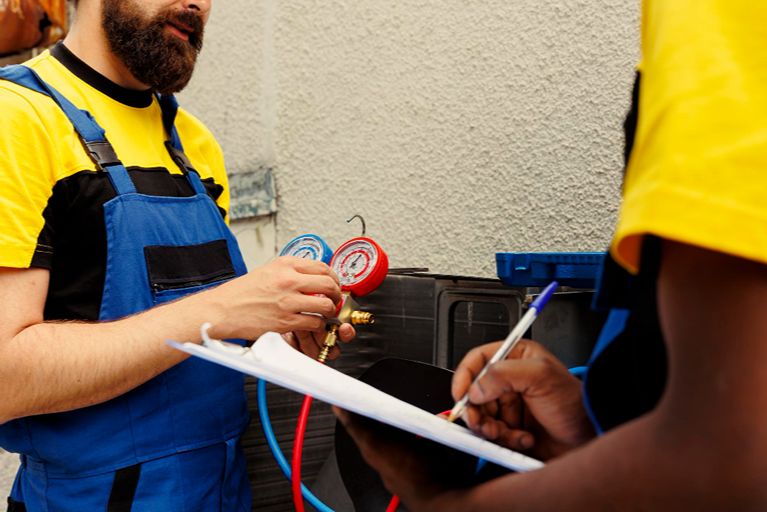
A detailed AC inspection checklist includes six basic technical steps: cleaning filters, cleaning out the condensate drain tray, checking the refrigerant pressure, washing the condenser coils, calibrating the thermostat and checking electrical connections for wear or loose terminals.
1. Air Filter & Grill Sterilization
What to do: Clean filters with non-corrosive antibacterial chemicals to eliminate dust and particulate matter in the air.
Why it matters: A clogged filter can restrict airflow by 20–40% and cause the compressor to work harder. This is especially critical given the desert sand in Dubai.
Red flags to watch for:
- Filter is brown/gray after 2 weeks of cleaning.
- Weak airflow from vents.
- Musty smell from the AC unit.
- Increased electricity consumption without usage changes.
Frequency: Every 4–6 weeks (summer), every 8–12 weeks (winter).
DIY or professional? Basic washable filters can be cleaned at home (gently rinsed in water), but professional antibacterial chemical cleaning costs AED 50–150 and is recommended quarterly.
2. Condensate Line Flush
What to do: Empty and clean drainage lines with a vacuum and chemical flush to remove algae, sludge and fungal biofilms.
Why it matters: Water backed up into your ceiling is caused by clogged drain lines, which leads to costly water damage and mold colonies. Dubai is humid and biological growth is rapid.
Red flags to watch for:
- Water collection around indoor AC units.
- Stains or water marks on the ceiling.
- Drain line gurgling/buzzing noises.
- Unpleasant odors around AC units.
Frequency: Every 4 weeks during summer; monthly inspection all year round.
Cost: AED 200–400 (professional chemical flush).
3. Evaporator and Condenser Coil Wash
What to do: Wash the indoor evaporator coils and the outdoor condenser coils with a chemical wash. The accumulation of debris and dust directly affects thermal heat transfer efficiency.
Why it matters: Dirty coils can reduce cooling capacity by 10–25%. This makes your compressor work harder and longer, using more electricity and wearing out faster.
Red flags to look for:
- AC is running but not cooling properly.
- Indoor coil icing.
- Weak cold air inside but outdoor unit fan is running constantly.
- Short cycling — repeated cycling of system on and off.
Frequency: Chemical wash semiannually (April and September); routine inspection monthly.
Cost: AED 350–700 (deep chemical cleaning) vs. AED 150–250 (basic cleaning).
4. Refrigerant Pressure Check
What to do: Calibrate digital manifold gauges to measure suction and discharge pressure levels and compare to OEM (Original Equipment Manufacturer) specifications.
Why it’s important: Low refrigerant is a gas leak, which is a serious problem. High pressure means the condenser is clogged or the compressor valve is bad. Both cut cooling and raise costs.
Red flags to watch for:
- Running system but cold air weak or not at all.
- Hissing noise near outdoor unit (refrigerant leak).
- System repeatedly turning on and off (short cycling).
- Sweating or frosting of the outdoor unit.
Frequency: Quarterly, and immediately if performance falls.
Cost: AED 100–200 (pressure check), AED 200–550 (refill if required).
5. Electrical & Contactor Check
What to do: Use special electrical testing equipment to check capacitor capacitance, compressor running amperage, and terminal wire tightness.
Why it matters: Loose electrical connections can cause fires, component failures and system breakdowns.
Red flags to look for:
- Odor of smoke from outdoor unit.
- System won’t boot or boots sporadically.
- AC turns on and trips the circuit breaker; outdoor unit is sparking.
Frequency: Every 3–4 months, annual for high-use systems.
Cost: AED 150–300 (inspection + fix).
6. Airflow Calibration
What to do: Check supply-air vs return-air temperature differential with a digital thermometer. The target is an 8°C–12°C temperature drop between supply and return.
Why it matters: The temperature differential tells you how well the system is cooling. If it is below 8°C there is not enough airflow; if it is above 12°C there is not enough cooling capacity.
Red flags to look for:
- Uneven cooling in various rooms.
- Some vents blow cold, others warm.
- High electricity bills with thermostat turned down.
- Weak flow from most vents.
Frequency: Every 2–3 months during the cooling season.
Cost: AED 100–200 (part of routine service).
Table 3: Inspection Checklist Summary
| Inspection Step | Frequency | Cost | Warning Signs | Priority |
|---|---|---|---|---|
| Air Filter Cleaning | Every 4–6 weeks (summer) / 8–12 weeks (winter) | AED 50–150 | Weak airflow, musty smell, brown filter | Critical |
| Condensate Line Flush | Every 4 weeks (summer), monthly inspection | AED 200–400 | Water leaks, ceiling stains, gurgling | Critical |
| Coil Washing | Twice yearly (April & September) | AED 350–700 | Weak cooling, ice formation, short cycling | High |
| Refrigerant Pressure | Quarterly + on demand | AED 100–550 | Weak cooling, hissing sounds, frosting | High |
| Electrical Check | Every 3–4 months | AED 150–300 | Burning smell, won’t start, tripped breaker | High |
| Airflow Calibration | Every 2–3 months (summer) | AED 100–200 | Uneven cooling, weak vents, high bills | Medium |
Source: EPA Indoor Air Quality Standards
Why Do High-Density Districts Like Business Bay Require Customized Maintenance?
Properties in high-density districts such as Business Bay require specialized maintenance because of tower wind turbulence, substantial centralized chiller dependency, and high continuous occupancy in mixed-use residential and commercial spaces. High-rise buildings have specific pressure fluctuations and district cooling integrations that require specific technical care.
Stack effect in buildings is a common cause of condensation build-up, malfunction of the FCU actuator valve and unbalancing of airflow in high-rise apartments and commercial offices. Residents and facilities managers looking for tailored regional support can rely on dedicated renovation and maintenance services in Business Bay to ensure fast emergency turnarounds and building-code compliance.
Frequently Asked Questions
In Dubai, how frequently do air conditioning filters need to be cleaned?
In Dubai, air conditioning filters need to be cleaned every four to six weeks in the summer (May through September) and every eight to twelve weeks in the winter. Regular filter cleaning preserves indoor air quality and avoids sand buildup.
Why is my interior air conditioning ceiling unit leaking water?
Water leaks typically happen when dust, algae, and slime clog the condensate drain line, overflowing the drain pan. A fractured drain tray or frozen evaporator coils from low refrigerant are two more frequent culprits.
What is the average lifespan of an air conditioner in the United Arab Emirates?
With routine maintenance, an air conditioner in the United Arab Emirates usually lasts eight to twelve years. The operational lifespan of an unmaintained unit might be reduced to less than six years due to coastal humidity, intense summer heat, and fine dust.
Which thermostat setting is best for reducing electricity costs in Dubai?
Utility regulators advise setting the thermostat to 24°C (75°F). By eliminating needless compressor strain and monthly utility expenses, setting your air conditioner to 24°C strikes a balance between indoor comfort and energy economy.