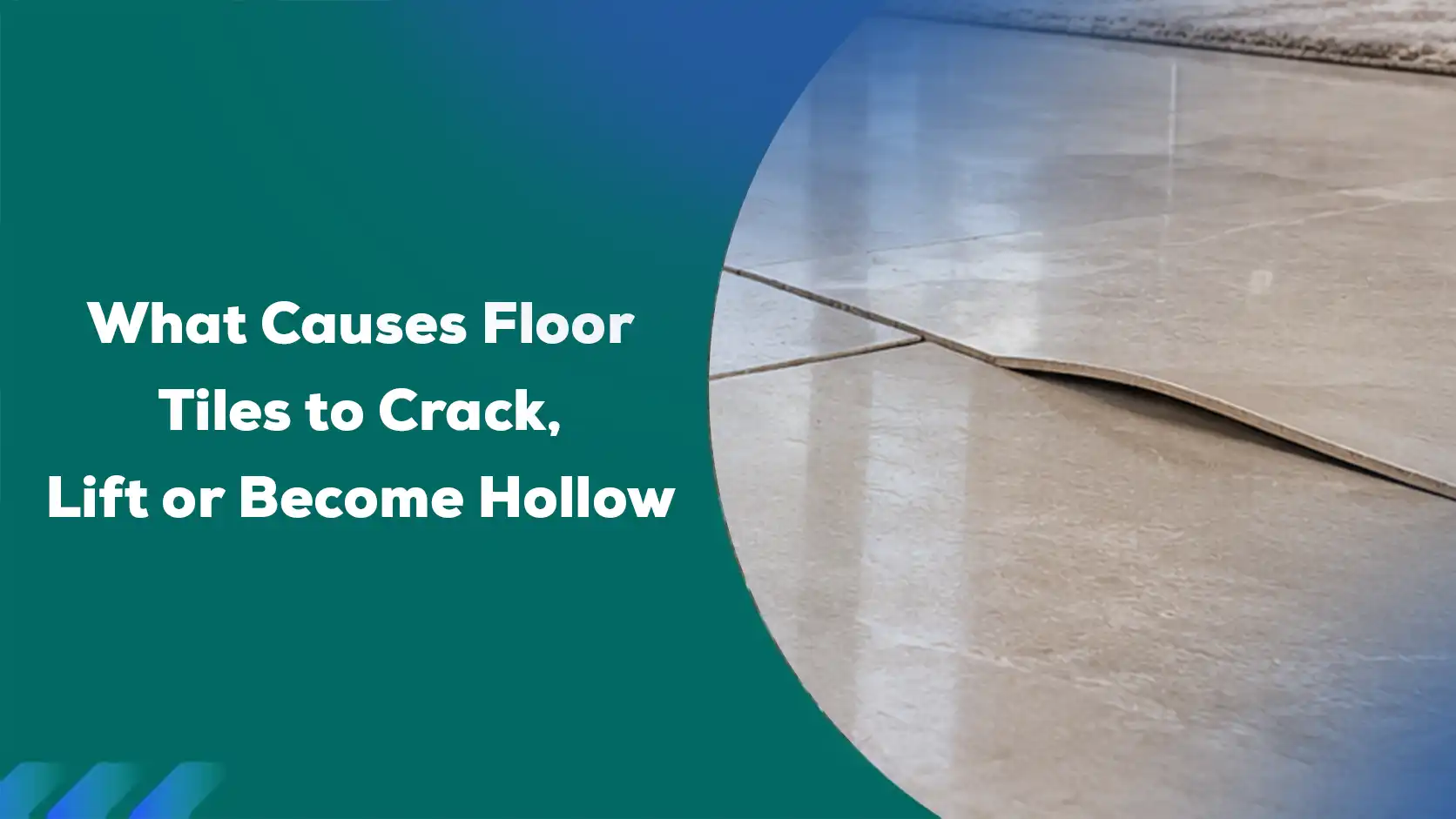
What Causes Floor Tiles to Crack, Lift or Become Hollow
Floor tiles crack, lift or sound hollow for one of two reasons: the bond between the tile and the floor has failed, or the floor underneath is moving. Poor adhesive coverage, an uneven base, missing movement joints, trapped moisture and repeated heat cycles are the usual triggers behind both.
In Dubai, summer heat and humidity add pressure, so a small installation fault can show up sooner. This guide explains what each symptom points to, what can be repaired, and how to stop the failure from returning.
Key Takeaways
- Tiles mostly fail because the bond is lost or the base is moving, not because the tile itself is weak.
- A hollow sound alone is not always a defect, but a hollow tile sitting next to solid ones is often loose.
- A crack running in a line through several tiles usually points to the floor below, not to impact.
- Tiles that tent or pop up are reacting to trapped pressure from heat, moisture or missing movement joints.
- One intact hollow tile can often be re-bonded. A cracked tile over a moving base needs the cause fixed first.
The Main Causes of Tile Failure
Most failed floors trace back to four causes: poor adhesive coverage, substrate movement, heat and moisture, and joints that cannot absorb stress. They often overlap, which is why a repair that fixes only the visible tile tends to fail again.
Poor adhesive and incomplete coverage
A tile carries load properly only when its whole back is supported. The ANSI A108.5 standard asks for at least 80% mortar contact in dry interior areas and 95% in wet ones, and Floor Trends notes that best practice applies the higher figure to every wet area. Too little mortar, mortar that skins over before the tile is pressed in, or no back-buttering on large tiles all leave voids. A void acts like a thin bridge: the tile sounds hollow first, then cracks when someone steps on the unsupported edge.
Weak or uneven substrate
The slab or screed does most of the work. If low spots deeper than 3 mm over 3 m are not filled, uncollapsed mortar ridges are more likely to remain under the tiles, and those ridges create the voids. Dust, oil and curing compounds on the base stop adhesive from gripping at all. New screeds also keep shrinking as they cure, so tiling too early builds movement into the floor.
Heat and thermal expansion
Tile, adhesive and slab expand and contract at different rates. Without movement joints or a flexible bond, that stress has nowhere to go and finishes as cracks or tiles popping off. Dubai makes it harder. Records from the National Centre of Meteorology for 1977 to 2016 show city maximums between 47.9°C and 48.8°C from June to August, with humidity reaching as high as 90%.
Moisture and trapped water
Water weakens adhesive, swells wood-based substrates and carries salts up through a slab. Floor Trends describes a home with plywood laid over concrete, where slab moisture changed how the wood moved and the tiles tented as a result. In Dubai the usual sources are leaking pipes, failed waterproofing in wet rooms and AC condensate lines draining onto the floor. Adhesive does not bond reliably to a damp base, so the water source has to be stopped before anything is re-bonded.
Missing movement joints and rigid grout
Tile laid wall to wall with grout pushed tight against the skirting has no room to expand, so pressure builds along the weakest line and the tiles buckle or crack. Rigid grout passes the same stress between neighbouring tiles. Movement joints at edges, thresholds and large runs, filled with flexible sealant, are meant to take that load. An uncoupling membrane goes further: according to Schluter, its open-rib structure lets the subfloor and the tile move independently.

Hollow vs Cracked vs Lifted: What Each Means
Hollow means the bond is partly gone, cracked means the tile has been overloaded, and lifted means pressure is building sideways or from below. Each symptom points to a different layer of the floor.
Hollow tiles
Tap the floor with a coin edge or a rubber mallet and listen for a dull, empty note. TileLetter points out that a hollow sound by itself is not classed as a defect. The concern is the pattern: CTASC explains that when some tiles sound solid and others hollow, the hollow ones are probably loose or poorly bonded, and cracking grout around them backs that up. Mark every hollow tile before fixing one, because there are rarely just one or two.
Cracked tiles
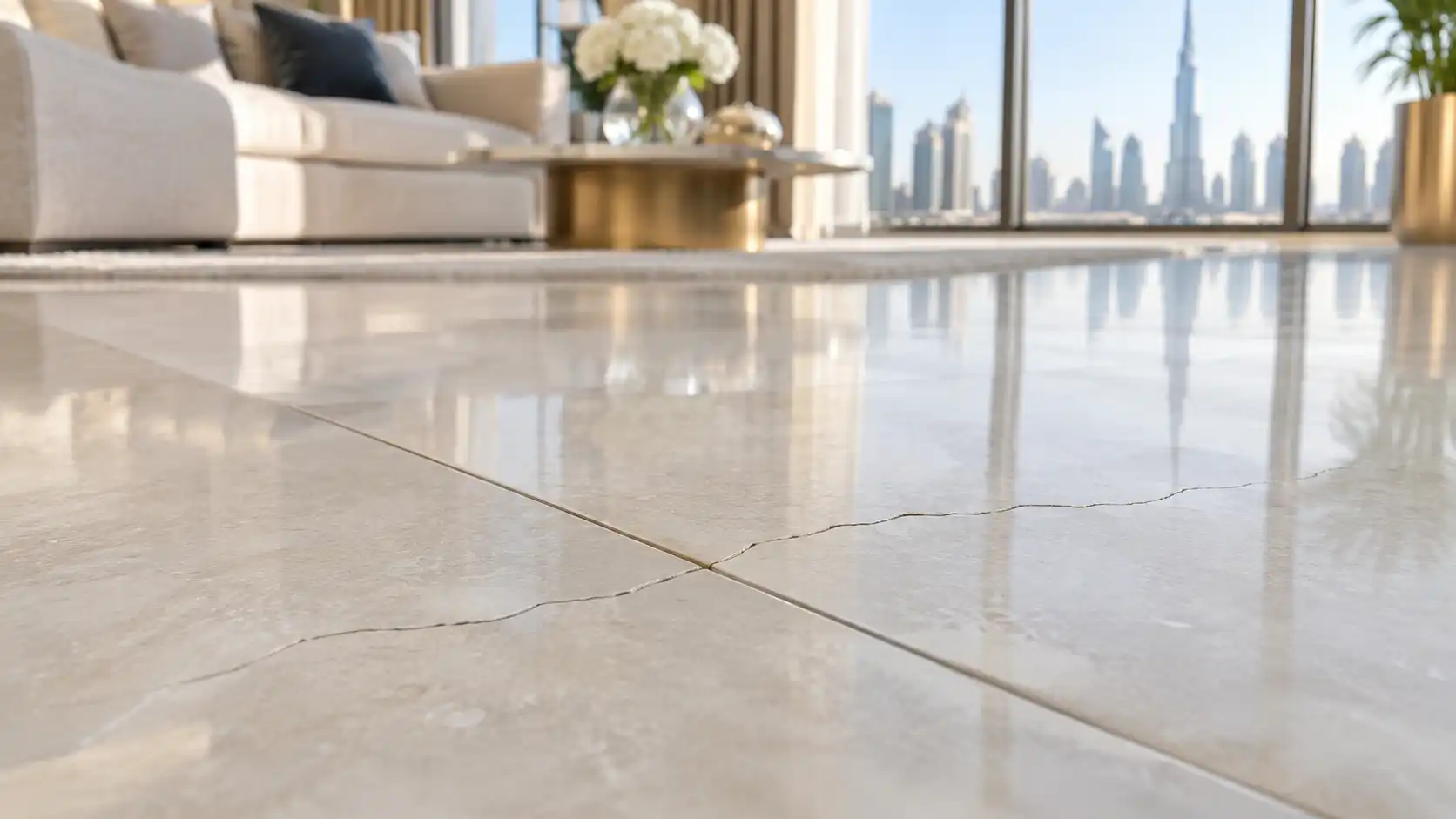
A star-shaped crack on one tile usually means impact, or a void under that exact spot. A hairline crack that runs straight through several tiles points to a crack in the slab below showing through. Cracks in the middle of a room on a floor that feels bouncy suggest deflection in the subfloor. If cracks keep returning after repair, the movement is still active.
Lifted or popping tiles
Tiles that rise into a ridge, or pop up with a sharp crack, are reacting to compression. The usual sources are expansion with no joint to release it, swelling from moisture, or a base that has shifted. This is the symptom most likely to spread if left alone, because the neighbouring tiles carry the load next.
Comparison Table: Symptom, Cause and Fix
Use this table to match what you see on the floor with the most likely cause and the usual remedy.
| Symptom | Likely cause | Usual fix |
|---|---|---|
| One or two hollow tiles, no cracks | Voids from low mortar coverage | Epoxy injection through small holes in the grout joints |
| Hollow sound across a wide area | Bond failure or poor coverage over the floor | Lift and re-lay the area with full-bed adhesive |
| Single tile with a star-shaped crack | Impact or a void under the tile | Replace the tile after checking the base |
| Crack running through several tiles | Slab crack or substrate movement | Repair or isolate the base, then re-lay over an uncoupling membrane |
| Diagonal cracks on a bouncy floor | Deflection in a weak subfloor | Stiffen the subfloor before retiling |
| Tiles lifting into a ridge | Missing movement joints, heat or moisture | Relieve pressure, trace the water, re-set the tiles |
| Cracks returning after repair | Ongoing movement | Find and fix the cause before any new tile goes down |
Can It Be Repaired or Must It Be Replaced?
Repair works when the tile is intact and the cause is gone. Replacement is needed when a tile is cracked through, the hollow area is large, or the base is still moving.
Epoxy injection is the main repair for a hollow tile, and it suits tiles with no crack through the body. According to Dynamic Stone Tools, a hollow zone covering more than half the tile means it should be re-set rather than injected, and epoxy does not bond reliably to a wet base. Hairline cracks in a stable floor can be filled with colour-matched epoxy, but that is cosmetic and does nothing for the bond.
Natural stone floors need extra care. Construction Canada suggests 95% coverage for stone because it is not as strong as ceramic, which is why cracked marble over a void is hard to save. The sounding, level checks and moisture testing that decide the right repair are where professional tilers add the most value, since the cause rarely shows on the surface.
| Situation | Repair possible? | Better option |
|---|---|---|
| A few hollow tiles, no cracks | Yes, by injection | Re-set if injection fails |
| Tile cracked through | No | Replace the tile |
| Hollow area over half the tile | Unlikely | Lift and re-set |
| Tiles tented or popping | Not yet | Find the cause, then re-lay |
| Cracks that keep returning | No | Fix the base, then re-lay |
How to Prevent Tile Failure
Prevention comes down to preparation, coverage and movement control, all settled before the first tile is set.
- Prepare the base. It should be flat, clean, dry and fully cured, with low spots filled.
- Match adhesive to the job. Large tiles, stone and wet areas need a polymer-modified adhesive and back-buttering.
- Check coverage as you go. Lift a tile after setting it and look at the back. Mortar should also be spread only where tiles can be placed before it skins over, which matters in Dubai heat.
- Add movement joints. Leave them at edges, thresholds and large runs, and fill them with flexible sealant instead of grout.
- Isolate risky bases. An uncoupling membrane suits slabs that may crack or flex.
Tile type and size also affect how a floor handles load and heat, and our guide to choosing the right tiles covers that in more detail. For a look at correct sequencing, the walkthrough on laying floor and wall tiles shows how layout and setting order work together.
FAQs
Why do my floor tiles keep cracking?
Because the cause was never fixed. Repeat cracking almost always means the base is still moving, voids sit under the tile, or movement joints are missing. Replacing single tiles treats the symptom, and the new tile fails the same way.
What causes tiles to lift?
Compression. Heat expansion, moisture swelling or a shifting base pushes tiles against each other until the weakest bond gives way. Weak adhesive and missing movement joints make it far more likely.
Why do tiles sound hollow?
The adhesive is not touching the full back of the tile. Low mortar coverage, uncollapsed trowel ridges on an uneven base, or a bond that has weakened over time are the usual reasons. Some assemblies, such as those over membranes, also sound hollow without being faulty.
Can cracked tiles be repaired?
Sometimes. Hairline cracks on a stable floor can be filled with colour-matched epoxy, though that is cosmetic. A tile cracked through is best replaced, and any crack that returns means the floor below needs assessing first.
How do you fix hollow tiles?
Drill small holes in the grout joints, vacuum out the dust and inject low-viscosity epoxy until it shows at the neighbouring holes, then fill the holes with matching grout. This works only when the tile is intact and the base is dry.
Book Tile Repair
If tiles in your apartment or villa are cracking, sounding hollow or popping up, the fix depends on what is happening under them. Send photos of the damaged area to the Hausfits tiling team to find out whether you need a re-bond, a replacement or a base repair. The team works across Dubai, including renovation and maintenance in Al Barsha, so a site visit can be arranged close to you.