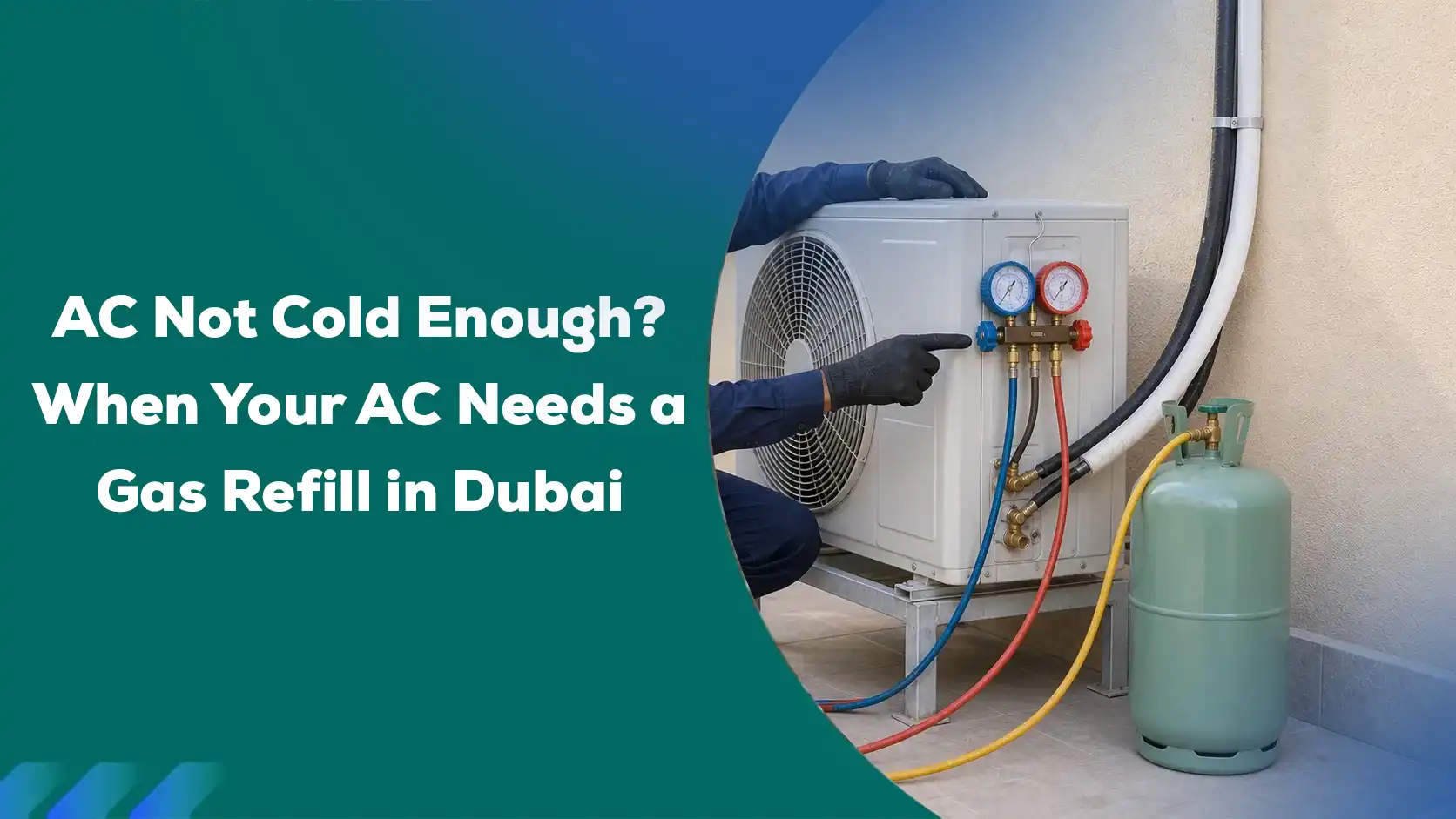
AC Not Cold Enough? When Your AC Needs a Gas Refill in Dubai
Your AC needs a gas refill when it runs normally but blows weak or warm air, ice forms on the indoor coil or copper pipe, or you hear hissing near the unit. In a healthy system, refrigerant is never used up, so low gas almost always means a leak that must be repaired before any regas.
That distinction matters in Dubai, where a split unit works for most of the day from May to September. A slow leak that goes unnoticed in March becomes a full breakdown by July, when every technician in the city is booked. This guide covers the signs, the causes, the realistic costs and the point where a refill stops making sense.

Key Takeaways
- Refrigerant moves heat and is not consumed. If the level drops, gas is escaping.
- The clearest signs are weak cooling, ice on the coil or pipes, hissing, long run times and a rising DEWA bill.
- Dirty filters, dusty coils and a failed capacitor can imitate low gas, so rule them out first.
- A top-up without a leak repair usually lasts weeks, not seasons.
- Refrigerant work needs gauges, a vacuum pump and the correct gas type. Leave it to a qualified technician.
What AC Gas (Refrigerant) Actually Does
Refrigerant is the fluid that carries heat out of your home. Inside the indoor unit it evaporates in the evaporator coil and absorbs heat from the room air. The compressor then pushes it to the outdoor unit, where it condenses and releases that heat outside. The cycle repeats for as long as the AC runs.
Because the loop is sealed, the gas is never burned off the way fuel is. HVAC.com explains that low refrigerant usually signals a leak, and that adding more without repairing it only buys a short delay.
Most homes in Dubai use R410A or R32, while older units may still run R22. The type is printed on the outdoor unit nameplate, and gases should never be mixed. The UAE has also been moving away from older refrigerants, so gas for very old units can be harder to source.
6 Signs Your AC Is Low on Gas
Any single sign can have another cause. Two or three together make low refrigerant likely.
1. Weak cooling, or an AC running but not cooling
The fan blows and the compressor hums, yet the room never reaches the set temperature. This is the usual answer to “why is my AC running but not cooling”, and also the symptom most easily caused by a clogged filter.
2. Ice on the indoor coil or copper pipes
Low gas drops pressure, which pushes the evaporator coil below freezing. Moisture in the air then freezes on it, leaving frost on the thicker copper line or a block of ice behind the grille. Switch the unit to fan mode to thaw it and do not chip the ice.

3. Hissing or bubbling sounds
A hiss or bubbling noise near the indoor unit or pipework can mean gas is escaping through a crack or a loose joint.
4. A higher DEWA bill with no change in habits
With less gas in the loop, the compressor works longer to deliver less cooling. If your bill climbs while your usage stays the same, the AC is the first place to look.
5. The outdoor unit never seems to switch off
A healthy unit cycles off once the room reaches temperature. Constant running in a room that stays warm suggests the system cannot move enough heat.
6. Oily residue on pipe joints
Refrigerant carries a little compressor oil with it. A greasy film at a flare joint or on the outdoor valves often marks the leak point.
Why Refrigerant Runs Low: Leaks vs Normal Loss
A correctly installed AC has no normal loss. It should hold its charge for years. Very old units may seep a trace, but one that needs gas every season has a leak.
Common leak points
- Joints and connections: flare nuts and brazed joints where the indoor and outdoor pipes meet, especially after a rushed installation.
- Coil pinholes: corrosion can pierce the evaporator or condenser coil, and humid coastal areas such as Dubai Marina and Palm Jumeirah can speed it up.
- Vibration cracks: copper lines crack when the outdoor unit is poorly secured.
- Service valves: worn valve cores let gas seep out slowly.
- Renovation damage: drilling or crushing a concealed pipe during fit-out work.
Why Dubai conditions make it worse
Long run times keep system pressure high. Dust on condenser coils pushes it higher still, which stresses joints and seals. A pre-summer check from a seasonal maintenance checklist catches most of this before the first heatwave.
Comparison Table: Symptom, Likely Cause, Fix
| Symptom | Likely cause | Fix |
|---|---|---|
| Weak airflow, room cools slowly | Dirty filter or blocked vents | Clean or replace the filter, clear the vents |
| Cool but weak air, ice on coil | Low refrigerant or restricted airflow | Switch off, thaw, then have pressure tested |
| Warm air, outdoor fan not turning | Failed capacitor or contactor | Electrical repair by a technician |
| Warm air, hot and noisy outdoor unit | Dirty condenser coil or failing compressor | Coil cleaning, then compressor diagnosis |
| Hissing, oily joints, repeat top-ups | Refrigerant leak | Leak test, repair, then recharge by weight |
| Water dripping indoors | Blocked drain or melting ice from a frozen coil | Clear the drain and check the gas level |
| Room cools but bill is high | Low gas, dirty coils or an ageing unit | Full service and efficiency check |
If your building uses district cooling, the indoor unit runs on chilled water rather than refrigerant gas, so a regas does not apply. Contact building management or a central and ducted systems technician instead.
Why ‘Just Refill the Gas’ Often Isn’t Enough
A top-up treats the symptom. If the leak stays open, the gas escapes again and cooling fades within weeks. Each repeat adds cost, and running a unit low on gas strains the compressor, the most expensive part to replace.
What a proper regas involves
- Measure pressures and airflow to confirm low gas rather than another fault.
- Find the leak with an electronic detector, a soap solution or a nitrogen pressure test.
- Repair the joint, coil or pipe section.
- Vacuum the system to remove air and moisture.
- Recharge by weight to the manufacturer specification, then verify temperatures.
Can I refill AC gas myself?
No. The job needs manifold gauges, a vacuum pump and the exact refrigerant, charged by weight. Too much gas or air left in the loop can damage the compressor, and DIY kits cannot find the leak. If you rent, tell your landlord first, since AC maintenance duties are often set out in the tenancy contract.
Regas vs Repair vs Replace
The right call depends on unit age, leak location and the quote. Use this as a starting guide.
| Situation | Best option | Why |
|---|---|---|
| Newer unit, first low-gas issue, leak at an accessible joint | Repair the leak and regas | Low cost against years of remaining life |
| Leak inside the evaporator or condenser coil | Coil repair or replacement | Compare the quote with a new unit |
| Gas needed twice in one season | Full leak diagnosis | A top-up is not a fix |
| Unit over 10 to 12 years old, R22 gas or failing compressor | Consider replacement | Parts and gas cost more and last less |
| Unit owned by the landlord | Report it in writing | Check who pays under the contract |
A common rule of thumb says to look hard at replacement when a repair quote passes half the price of a new unit of the same size. Costs also vary widely, so here are indicative AC gas top up cost ranges for a split unit in Dubai.
| Service | Indicative cost (AED) | What it usually covers |
|---|---|---|
| Gas top-up only | 250 to 450 | Pressure check and gas added, no leak repair |
| Leak detection, repair and regas | 600 to 1,200 | Leak found and fixed, vacuum, recharge by weight |
| Compressor replacement (1.5 to 2 ton) | 1,800 to 3,800 | Parts and labour |
These figures are market estimates and shift with unit size, refrigerant type and access. Ask for a written quote that separates diagnosis, repair and gas, and compare it with what AC servicing costs. An annual maintenance contract spreads the checks across the year and catches slow leaks early. Dusty ducts also cut airflow, which mimics low gas, so duct cleaning is worth ruling out.
FAQs
How do I know if my AC needs gas?
Look for weak cooling, ice on the coil or pipes, hissing, long run times and a rising DEWA bill at the same time. A technician confirms it by measuring system pressure, because a dirty filter or faulty capacitor can look identical.
Why is my AC running but not cooling?
The usual causes are a dirty filter, dusty coils, a failed capacitor or low refrigerant. Start with the filter, which should be cleaned about once a month in summer. If ice or hissing appears as well, low gas becomes the likely cause.
How often does an AC need regassing?
Never on a schedule. A sealed system only needs gas when it leaks. If yours needs gas every season, the leak is the real problem and needs repair.
Can I refill AC gas myself?
No. Correct charging needs gauges, a vacuum pump and the right refrigerant by weight, and a refill does not repair the leak. Hire a qualified technician.
How much does an AC gas top-up cost in Dubai?
A top-up alone commonly costs AED 250 to 450 per split unit. With leak detection and repair, expect roughly AED 600 to 1,200. Final prices depend on unit size, gas type and how hard the pipework is to reach.
Book a Cooling Check
If your AC is running but the room will not cool, a quick inspection costs far less than a failed compressor in July. Hausfits technicians check refrigerant levels as part of AC maintenance, trace the cause before adding any gas and agree the price before work starts. You can book a cooling check through the AC services team or call +971 52 2626 899.