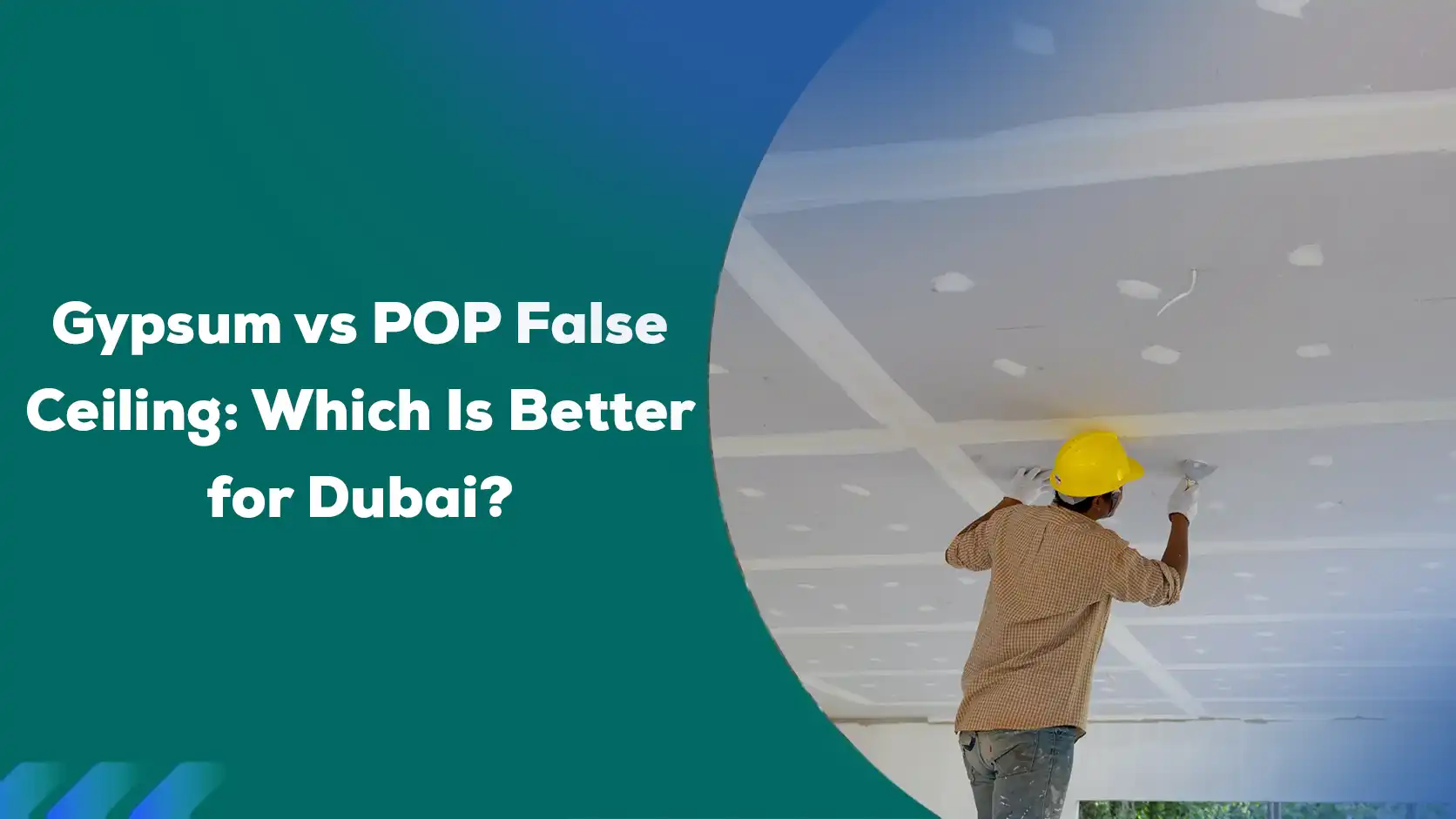
Gypsum vs POP False Ceiling: Which Is Better for Dubai?
Gypsum board is the better false ceiling for most homes and offices in Dubai. It installs faster, leaves a flatter finish, copes better with the air conditioning services above it, and can be patched without redoing the whole ceiling. POP (Plaster of Paris) is still the stronger choice for hand-moulded cornices, domes and ornate detail, which is why many villa and majlis ceilings use both.
The difference starts with how each one is made. Gypsum is a factory-made board screwed to a metal frame. POP is a plaster powder mixed with water, then shaped on site or cast in moulds. That one fact drives cost, finish, mess and repair.
Dubai adds variables general guides skip: AC condensation in ceiling voids, building approvals, board grades and AED pricing.

Key Takeaways
- Default pick: gypsum board suits most Dubai apartments, bedrooms and offices. POP suits ornate, hand-finished detail.
- Cost: plain gypsum is usually the lowest-priced option in Dubai. Decorative POP generally costs more per sq ft because it needs skilled on-site labour.
- Moisture: both materials are gypsum-based and both suffer from leaks. The board grade and a dry ceiling void matter more than the base material.
- Wet rooms: use moisture-resistant gypsum in kitchens and bathrooms, and fit access panels wherever valves, fan coil units or junction boxes sit.
- Hybrid: a gypsum base with POP mouldings gives most of the benefit of each.
How Gypsum Board Ceilings Work
A gypsum board ceiling is a suspended steel frame covered with factory-made boards, then taped, filled and painted so the surface reads as one flat plane. Each board is a gypsum core wrapped in paper, and a common size is 12.5 mm thick by 1200 x 2400 mm, as listed in Gyproc’s moisture resistant board data. Installers hang galvanised channels from the slab, screw the boards on and treat the joints.
Because boards are cut and fixed dry, the work is quick and comparatively clean. A typical apartment ceiling can be framed, boarded and ready for paint within days, and the void above stays usable for cabling, downlights, LED cove channels and AC ducting. It is the same board-and-frame system used for gypsum partitions, so one crew can often handle both. Most false ceiling services in Dubai install board ceilings by default for these reasons.

Where gypsum board works well
- A flat, even finish that suits modern interiors, shadow gaps and cove lighting
- Consistent thickness and weight, so lighting and AC coordination is predictable
- Moisture-resistant and fire-rated grades for wet rooms and regulated spaces
- Sections can be cut open for access and patched afterwards
Where it falls short
- Standard board absorbs water, so leaks cause sagging, staining and mould
- Joints can crack if movement is not planned for, especially on wide spans
- Tight curves and deep ornament need special boards or added mouldings
How POP (Plaster of Paris) Ceilings Work
A POP ceiling is made from plaster of Paris powder mixed with water, then applied over a framework or cast into moulded pieces and fixed in place. Chemically, POP is calcium sulfate hemihydrate, produced by heating gypsum to roughly 120 to 180 °C, and it hardens again once water is added, according to Britannica. The same entry notes its long use for precast ornamental plasterwork on ceilings and cornices.
That fast set lets a skilled plasterer form coffers, domes, curves and cornice profiles that board cannot match cleanly. The price of that freedom is dependence on craftsmanship. Mixing and sanding on site create dust and slurry, finishing takes longer, and large poured surfaces can show hairline cracks where the ceiling moves or where openings are cut for lights.
Where POP works well
- One-off decorative work such as domes, coffers, cornices and ceiling roses
- Curved, layered profiles with no visible board joints
- Matching or repairing existing plaster ceilings
Where it falls short
- Slower, messier installation with drying time before paint
- Finish quality varies with the plasterer
- Local repairs often show unless a wider area is re-skimmed

Comparison Table: Cost, Finish, Durability and Installation Time
Gypsum board wins on speed, finish consistency and serviceability. POP wins on decorative freedom. Cost follows how much detail the design needs.
| Factor | Gypsum board | POP |
|---|---|---|
| Material | Factory-made boards on a steel frame | Plaster mixed on site or precast, over a frame |
| Installation time | Days for a typical apartment | Longer: mixing, shaping and drying before paint |
| Finish | Flat and uniform, joints concealed | Seamless with sculpted detail, varies by plasterer |
| Design range | Straight lines, steps, cove lighting, gentle curves | Domes, coffers, ornate mouldings |
| Durability | Stable when dry, water-sensitive unless moisture-resistant board is used | Stable when dry, also water-sensitive |
| Mess on site | Low: dry fixing with joint sanding | High: wet mixing and sanding |
| Repairs | Cut out and patch a section | Re-skim a wider area to hide the repair |
| Indicative cost in Dubai | AED 8 to 25 per sq ft plain; AED 20 to 50 with cove or levels | AED 30 to 70 per sq ft for decorative work |
| Best for | Homes, offices, bedrooms, clean modern design | Majlis, formal lounges, ornate villa ceilings |
Cost figures are indicative ranges drawn from Dubai contractor rate cards published in 2025 and 2026. Site conditions change them.
Gypsum False Ceiling Cost in Dubai
A plain gypsum ceiling in Dubai usually costs about AED 8 to 25 per sq ft installed, rising to roughly AED 20 to 50 with cove lighting, extra levels or curves. Published rates vary widely because quotes include different things. Unlike markets where POP is the cheaper material, rate cards in Dubai generally show decorative POP above plain board work.
What moves the number: board grade, levels, metres of cove, downlight points, access panels, removal of an old ceiling and paint. When comparing quotes, check whether lighting, paint and approvals are included, and whether the rate is per sq ft or per sqm.
Which Suits Dubai’s Climate Better
Gypsum board is the better fit, as long as the board grade matches the room. Dubai’s annual average relative humidity sits near 59 percent according to climate normals compiled on Wikipedia, and summer humidity can climb toward 90 percent. Indoors, air is cooled for most of the year, so ceiling voids hold cold ducts and condensate lines inside a humid building.
Most ceiling moisture problems start with that plumbing rather than the weather: a sweating duct, a blocked drain line or a leak from the unit above. Standard gypsum board absorbs water and will sag, stain and grow mould. Moisture-resistant boards use additives to cut water absorption, and EN 520 classes them as Type H1, H2 or H3.
POP is not safer here. It is gypsum-based too, and it softens and stains when wet. The practical difference is repair: a stained board section can be cut out and replaced, while a large POP surface usually needs a wider re-skim to avoid a visible patch.
Large Spans and Movement
That matters in villa halls and double-height spaces. Ask the installer about framing spacing and control joints before work starts.
Building Rules and Approvals
In towers across areas such as Business Bay, JLT and Downtown, ceiling work usually needs building management approval, with rules on working hours, protection of common areas and dust control. Dry-fixed board sits more easily with those rules than wet mixing and sanding. Sprinkler heads, smoke detectors and AC grilles also have to be coordinated with the new ceiling under the UAE Fire and Life Safety Code. Confirm requirements first. For tower projects, see how renovation and maintenance work in Business Bay is typically handled.
Best Choice by Room and Budget
Use gypsum board for most rooms, moisture-resistant board in wet areas, and POP or a gypsum and POP hybrid where a formal room needs decorative detail.
| Room | Best choice | Note |
|---|---|---|
| Living room | Gypsum with cove lighting | A perimeter drop keeps full height in the centre |
| Bedroom | Plain or single-step gypsum | Soft indirect light works better than heavy layering |
| Kitchen and bathroom | Moisture-resistant gypsum | Check hood, extraction and AC drain routing before boarding |
| Majlis or formal reception | Gypsum base with POP mouldings | Ornament where it is seen, board everywhere else |
| Villa double-height hall | Gypsum with closer framing and control joints | See the span note above |
| Office or retail unit | Gypsum, fire-rated where required | Coordinate sprinklers, detectors and access panels |

By Budget
- Tight budget: single-level flat gypsum with a perimeter drop. Standard board in dry rooms, moisture-resistant board only where needed.
- Mid-range: gypsum with cove lighting, moisture-resistant board in wet areas and access panels at every service point.
- Premium: multi-level gypsum with POP mouldings in formal rooms, and fire-rated specification where the building requires it.
False Ceiling Design in Dubai: What Works
Current false ceiling design in Dubai leans toward flat boards with a shadow gap or recessed cove, linear LED lines and a perimeter drop that hides curtain tracks and AC pipework. Heavy multi-tier ceilings reduce height in apartments and add cost. Gypsum handles these details cleanly. POP earns its place in formal, ornate rooms.
FAQs
Is gypsum board better than POP?
For most Dubai homes and offices, yes. Gypsum installs faster, finishes flatter and is easier to repair and service. POP is better only when you want hand-moulded or highly ornate detail.
What is the difference between gypsum and POP ceiling?
A gypsum ceiling uses factory-made boards fixed to a metal frame. A POP ceiling uses plaster powder mixed with water and shaped on site or cast in moulds. Both come from the same mineral, so the difference lies in installation, finish and design flexibility.
Which false ceiling material is best?
Gypsum board is the best all-round material for Dubai, in a moisture-resistant grade for kitchens and bathrooms. Choose POP for decorative elements, or combine both. Metal and PVC panels suit specific cases such as commercial grids or very wet areas.
How much does a gypsum ceiling cost in Dubai?
A plain gypsum ceiling typically costs about AED 8 to 25 per sq ft installed. Cove lighting and multiple levels raise it to roughly AED 20 to 50. Quotes differ by board grade, lighting points, paint and approvals, so compare scope line by line.
Can gypsum ceilings handle Dubai humidity?
Yes, with moisture-resistant board and a dry ceiling void. The risk comes from AC condensation and leaks more than ambient humidity, so insulate ducts and keep drain lines clear.
Can I use gypsum and POP together?
Yes. A gypsum base with POP cornices or a centre medallion is common in villa lounges and majlis rooms. It keeps cost and mess lower than a full POP ceiling.
Get a False Ceiling Quote
Send room sizes, ceiling height, your building name and photos of the existing ceiling, and the team can recommend gypsum, POP or a hybrid for each space. A useful quote lists board grade, framing, levels, lighting points, access panels, paint and approvals as separate lines. You can request a site visit through the false ceiling services in Dubai page.