Why Is My Water Pressure Low? A Dubai Homeowner’s Guide
Low water pressure in a Dubai home almost always traces to one of five things: mineral scale clogging aerators and shower heads, a roof tank or booster pump that isn’t keeping up, a valve left partly closed after maintenance, a failing pressure reducing valve, or peak-hour demand in a tower. If the weak flow is at one outlet, it’s a fixture problem you can often solve yourself. If it’s everywhere, the cause sits upstream in the building.
That distinction matters more here than in most cities. Almost no water in Dubai arrives by gravity from a reservoir. It is desalinated seawater delivered by DEWA into a basement tank, lifted by transfer pumps to a rooftop tank, then fed back down to your apartment. Every stage is machinery, and machinery drifts out of calibration.
Table of Contents
Key Takeaways
- Not Usually “Your” Plumbing: Most pressure loss isn’t your plumbing. In apartments the usual culprits are shared equipment: the roof tank, the transfer pump, the booster set.
- The One Test That Matters: One tap is your problem. Every tap is their problem. This single test decides whether you call a plumber or building management.
- Cheapest Fix First: Scale is the cheapest and most common fix. A blocked aerator can halve flow at a fixture and takes about 15 minutes to clear.
- Last Resort, Not First: A booster pump is a last resort, not a first move. In apartments it usually needs written approval, and a badly specified pump can pull pressure away from neighbours.
- Rarely a Tenant Cost: Tenants rarely pay for pump or tank faults. Article 16 of Dubai’s tenancy law puts maintenance on the landlord by default, unless the contract says otherwise.
How Water Actually Reaches Your Tap in Dubai
Low water pressure in a Dubai home almost always traces to one of five things: mineral scale clogging aerators and shower heads, a roof tank or booster pump that isn’t keeping up, a valve left partly closed after maintenance, a failing pressure reducing valve, or peak-hour demand in a tower. If the weak flow is at one outlet, it’s a fixture problem you can often solve yourself. If it’s everywhere, the cause sits upstream in the building.
That distinction matters more here than in most cities. Almost no water in Dubai arrives by gravity from a reservoir. It is desalinated seawater delivered by DEWA into a basement tank, lifted by transfer pumps to a rooftop tank, then fed back down to your apartment. Every stage is machinery, and machinery drifts out of calibration.
Common Causes of Low Water Pressure

These seven causes account for most low water pressure complaints in Dubai homes, ordered roughly from most to least common.
1. Scale and Grit in Aerators, Shower Heads and Cartridges
Dubai’s water is remineralised after desalination, and hardness varies by area and by the age of the pipework. Over a year or two a chalky film narrows the openings in an aerator until flow drops by a third. Mixer cartridges collect the same deposits, along with sand shaken loose during tank cleaning.
2. Roof Tank and Booster Pump Problems
Most Dubai towers use a transfer-and-boost arrangement. If a float switch is coated in sediment, or a pump cycles on too late, the rooftop tank never fills properly. A half-full tank means a sputtering shower on the upper floors.
3. Valves Left Partly Closed
Underrated and very common. After any repair, someone has to reopen the isolation valves. A half-open angle valve under a sink convincingly imitates a serious system fault.
4. A Failing Pressure Reducing Valve (PRV)
Many apartments have a PRV at the unit inlet to protect fittings from high supply pressure, and they wear out. When the diaphragm fails it throttles the whole apartment evenly, hot and cold, which is why people describe it as the entire flat going weak overnight.
5. Peak-Hour Demand
Usage spikes between 6am and 9am, and again after 7pm. If pressure is fine at 11pm and poor at 7am, the system is at capacity rather than broken. Log the times before calling anyone.
6. Hidden Leaks
A leak on a concealed supply line bleeds pressure quietly. In villas, irrigation lines are the usual offender, and a rising DEWA bill with no change in habits is the giveaway.
7. Water Heater Faults (Hot Side Only)
Sediment, a partly closed heater inlet valve or a scaled element will weaken the hot side while the cold side stays strong.
Table 1: Which Cause Is Likely, and Who Has to Fix It
The table below places all seven causes side by side, so you can judge whether the fault is realistically yours to solve and how long the repair should take.
| Cause | How Common in Dubai | Who Normally Fixes It | Time to Resolve |
|---|---|---|---|
| Scaled aerator or shower head | Very common | You, or a plumber | 15–30 minutes |
| Roof tank or booster fault | Common in towers | Building management / FM | 1–5 days |
| Partly closed valve | Common after repairs | You, or a plumber | Minutes |
| Failed PRV | Moderate | Licensed plumber | 1–2 hours |
| Peak-hour demand | Common | Building management | Ongoing |
| Concealed leak | Less common | Licensed plumber | Half a day or more |
| Water heater fault | Moderate | Licensed plumber | 1–3 hours |
Is It Just One Tap or the Whole Home?
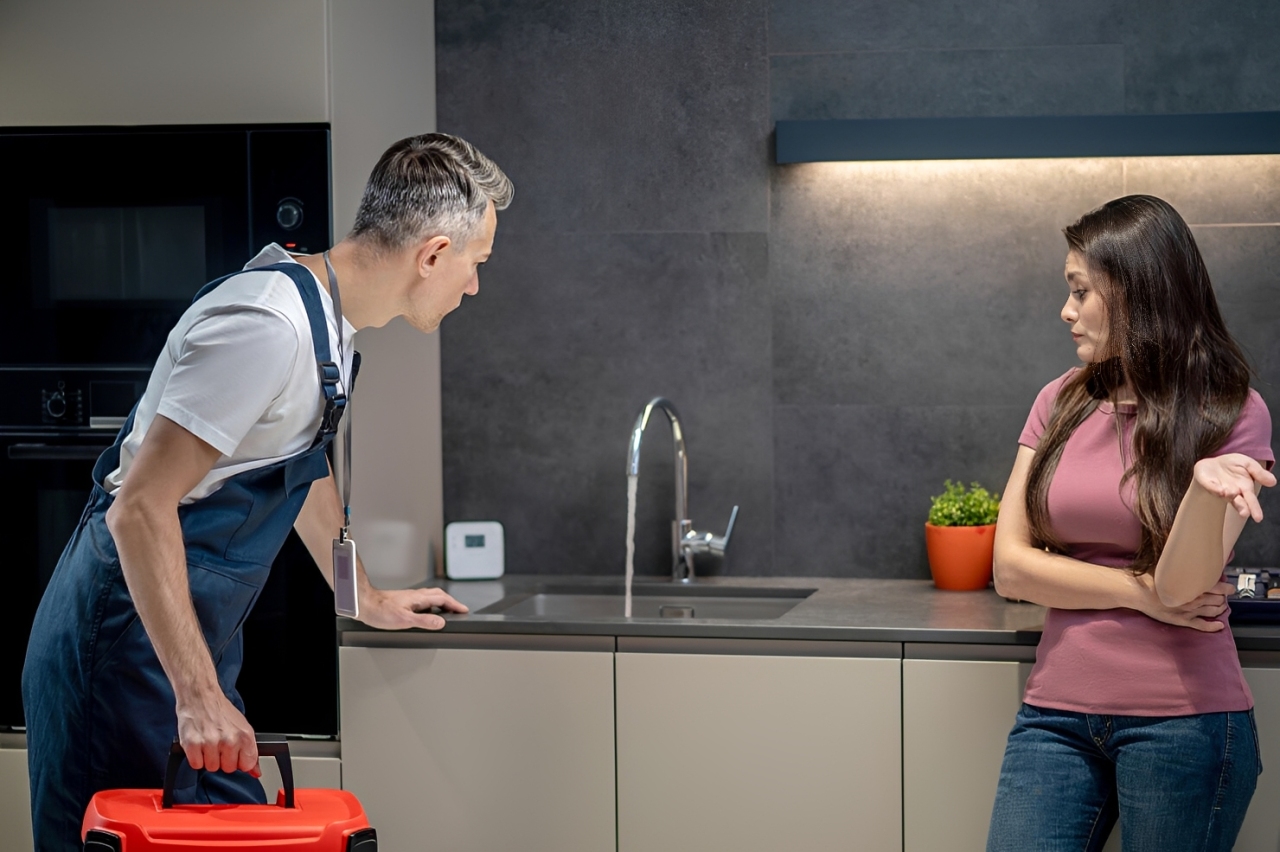
This is the most useful diagnostic in the guide and takes four minutes. Open the kitchen cold tap, then a basin, then the shower, checking hot and cold at each. The pattern tells you who owns the problem.
Rule one thing out first. If the tap runs weakly and the basin drains slowly, that is two unrelated faults, not one: supply and waste pipes never meet. Clear the drainage side first using the method in our guide to unblocking a sink, then come back and test the pressure properly.
One Outlet Only
The fault is at that fixture: aerator, cartridge, angle valve, or a kinked flexible hose. Nothing upstream is wrong.
One Bathroom, or One Side Only
Suspect the branch isolation valve for that room, or a blocked strainer where the branch leaves the riser. If only hot is weak, isolate to the water heater and its inlet valve.
The Whole Apartment, Hot and Cold
Check the unit inlet: PRV, main isolation valve, inlet strainer. If those are clear, the problem belongs to the building.
The Whole Building
One message to a neighbour on another floor confirms it. This is a tank, pump or supply issue, and it sits with the management entity.
Table 2: What Your Four-Minute Test Result Means
Match the pattern you observed to a row below. Each result narrows the fault to one part of the system and tells you who to contact next.
| Test Result | Likely Fault Location | Your Next Step |
|---|---|---|
| One tap weak | That fixture | Clean or replace the aerator or cartridge |
| One bathroom weak | Branch valve or strainer | Open valves fully, then call a plumber |
| Only hot weak | Water heater or hot valve | Service the heater |
| Whole unit weak | PRV or inlet valve | Plumber inspection |
| Neighbours affected too | Roof tank, booster set, DEWA supply | Report to building management |
Comparison Table: Symptom, Likely Cause, Fix
This table maps the six symptoms Dubai residents report most often to their likely cause, the fix that works, and whether you can handle it yourself.
Table 3: Symptom, Likely Cause, Practical Fix
| Symptom | Likely Cause | Practical Fix | DIY or Pro? |
|---|---|---|---|
| Shower spits, spray uneven | Scaled head or air in the line | Soak the head in descaler, bleed the line | DIY |
| Flow dropped overnight, everywhere | Failed PRV or a valve closed during works | Valve sweep first, then plumber | Mixed |
| Weak only morning and evening | Peak demand on the riser | Log times, raise with FM | Report |
| Weak on high floors only | Booster undersized or miscalibrated | Building-level pump service | Pro / FM |
| Hot weak, cold normal | Heater sediment or throttled inlet | Flush heater, open the valve | Pro |
| Weak flow plus slow-draining sinks | Two separate issues | Treat them separately: supply and drainage are unrelated systems | DIY first |
Quick Checks Before Calling a Plumber
Run these six checks in order. Most people find the cause at step one or three, and the sequence costs nothing but half an hour.
Step 1: Measure It, Don’t Guess
Fill a 10-litre bucket from the shower and time it; a healthy shower fills it in roughly 60–90 seconds. The US EPA puts a standard shower head at about 2.5 gallons per minute, around 9.5 litres, with efficient models capped at 2.0 gpm (EPA WaterSense). Anything under 5 litres per minute is a real problem rather than a matter of perception.
Step 2: Unscrew the Aerator
Hold it to the light and look for white crust or sand. Soak it in white vinegar or a citric descaler for an hour, rinse and refit.
Step 3: Do a Valve Sweep
Check every valve you can reach: under sinks, behind the toilet, at the heater, at the apartment inlet. Open each fully, then turn back a quarter turn.
Step 4: Compare Hot and Cold at the Same Tap
It takes ten seconds at each tap and narrows the search dramatically.
Step 5: Ask One Neighbour Above and One Below
If both report the same symptom, stop troubleshooting your flat and email building management with times and dates.
Step 6: Check for a Leak
Close every outlet, then watch the DEWA meter for fifteen minutes. Movement with everything shut means water is escaping.
What Not to Do
Don’t adjust the building’s pump settings and don’t remove a PRV to “free up” pressure. Both risk damaging equipment and shifting the problem onto neighbours.
Resources: DEWA Support · DEWA Smart Response
When You Need a Booster Pump or Professional Help
A booster pump is right only when supply is adequate but pressure is genuinely insufficient for the property, typically a villa with several bathrooms running at once or a top-floor unit on an undersized central booster. It is the wrong fix when the cause is a blocked fixture, a closed valve, a failed PRV or a neglected tank, because a pump only pushes water harder into the same restriction.
When a Booster Pump Makes Sense
- A villa where two showers plus irrigation drops everything to a trickle.
- A long horizontal run from the tank to the far bathrooms.
- A top-floor apartment where management has confirmed no fault.
When It Doesn’t
- Any case where one outlet is fine and another isn’t.
- Any case where neighbours share the symptom, since that is a shared-system fault the building must repair.
Approvals Matter in Apartments
Work touching shared risers normally needs a No Objection Certificate from building management or the management entity, and sometimes the master developer. Fitting a private pump onto a common riser without approval can breach community rules and draw pressure from neighbouring units. Villa owners in gated communities face a similar process.
Older Properties: When a Pump Is Treating a Pipework Problem
In villas and low-rise buildings from before the mid-2000s, the pipework itself is often the problem. Years of scale narrow the internal diameter until no pump can compensate, and adding one only strains joints that are already tired. The honest answer there is partial repiping, usually done alongside a bathroom or kitchen upgrade rather than as an isolated job, which is how we handle renovation and maintenance work in Sharjah, where the older housing stock makes this the rule rather than the exception.
Who Pays, Tenant or Landlord?
Under Article 16 of Law No. 26 of 2007, the landlord is responsible for maintenance and for repairing defects affecting the tenant’s intended use, unless the contract says otherwise. Most Ejari-registered contracts split this with a per-incident threshold, commonly around AED 500: the tenant covers small items and the landlord covers major works. A failed pump or PRV sits on the landlord’s side of that line (Khaleej Times · Gulf News).
Table 4: The Right Fix by Property Type
Property type changes both the likely cause and the person responsible for it. Here is how that plays out across the three most common cases.
| Property Type | Most Likely Cause | Usual Solution | Who Arranges It |
|---|---|---|---|
| Apartment, mid-floor | Scale or PRV | Fixture service, PRV replacement | Tenant, then landlord |
| Apartment, top floor | Booster calibration | Building pump service | Management entity |
| Villa, multiple bathrooms | Simultaneous demand | Correctly sized booster pump | Owner |
If the six checks point back to your own unit rather than the building, the next step is a proper pressure test: static and dynamic readings at the inlet, which tell a plumber in one visit whether the PRV, the strainer or the pipework is responsible. That diagnostic is standard practice for any licensed plumbing service in Dubai and costs far less than replacing parts by guesswork.
Resources: Dubai Land Department Rental Disputes Centre · DEWA water quality reports
FAQs
Why is my water pressure suddenly low?
A sudden drop means a valve or a mechanical failure, not gradual wear. Check whether anyone worked on the building’s water system in the last 48 hours, then check your isolation valves and PRV. Scale causes a slow decline over months; an overnight change points to something that moved or broke.
How do I increase water pressure at home?
Start with the free fixes: clean the aerators and shower head, open every isolation valve fully, replace worn mixer cartridges. If the home is still weak, have a plumber test static and dynamic pressure at the inlet. A booster pump comes last, once a shortfall has been measured rather than assumed.
Is low water pressure a plumbing problem?
Sometimes, but in Dubai apartments it often isn’t. If the weak flow affects one fixture or one unit, it is a plumbing problem for you or your landlord. If it affects several units or the whole building, it is a building services issue involving tanks and pumps, and under Dubai Law No. 6 of 2019 the management entity is responsible for those shared systems.
Why is my shower pressure weak?
Three causes cover most cases. A scaled shower head, which you test by removing it and running the bare arm. A worn thermostatic or mixer cartridge, which usually also causes temperature wandering. Or a hot-side restriction such as a throttled heater inlet, confirmed by comparing hot and cold at the basin.
How long should building management take to fix a pump fault?
There is no fixed statutory deadline, but loss of supply affects habitability. Report it in writing, keep the thread, and escalate to the Rental Disputes Centre at Dubai Land Department if written requests are ignored.
Still Weak After All Six Checks? Book a Pressure Test
Work through the six checks first, because they are free and they settle a good share of cases. If the flow is still poor afterwards, stop replacing parts on guesswork. A measured pressure test at the inlet identifies the fault in one visit, and tells you immediately whether the bill is yours or your landlord’s.
Hausfits handles exactly this across Dubai: PRV replacement, cartridge servicing, heater flushing, leak detection and correctly sized booster pumps. Tell us what your four-minute test showed. Book a plumber in Dubai, or send a photo of the fixture and we will tell you honestly whether it needs a call-out at all.