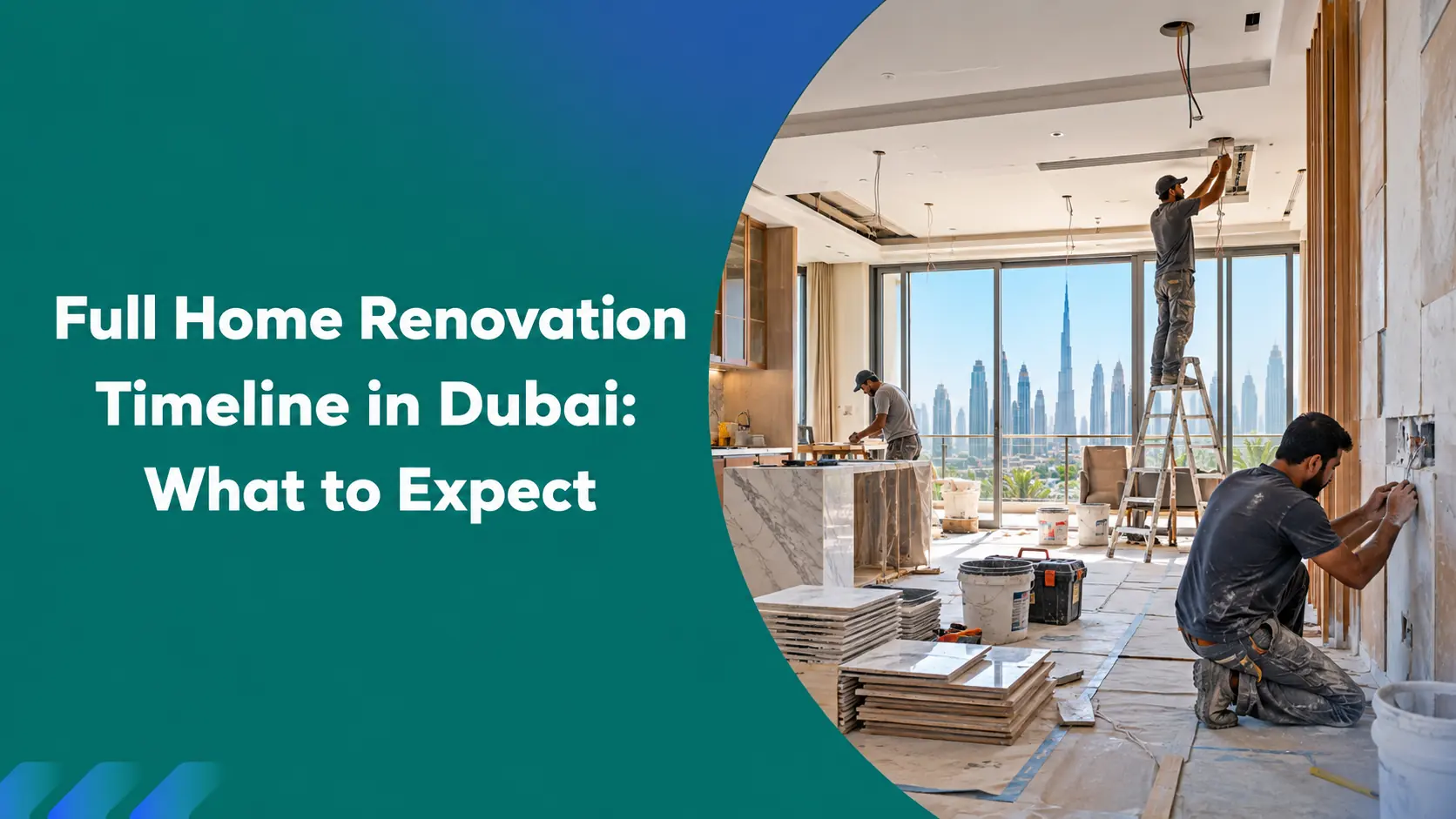
Full Home Renovation Timeline in Dubai: What to Expect
A full home renovation in Dubai takes about 10 to 20 weeks for an apartment, 18 to 33 weeks for a villa, and 24 to 45 weeks when the job is a complete fit-out with layout changes. Close to a third of that time passes before demolition begins, because design, authority permits and developer approvals have to be cleared first.
The range is wide because renovation is a sequence, not a single job. Each trade waits for the one before it, so a late permit or a missing tile order delays everything behind it. This guide breaks down each stage, how long it runs, what slows projects down in Dubai, and how to protect your handover date. If you are still defining the scope, our home renovation checklist covers the decisions to settle first.

Key Takeaways
- Plan for 10 to 20 weeks for an apartment, 18 to 33 weeks for a villa and 24 to 45 weeks for a full fit-out.
- Design and approvals take close to a third of the schedule and must finish before site work starts.
- Two approvals usually apply: a government authority permit and a developer or building NOC.
- Order custom joinery, stone and imported fixtures while approvals are still running.
- The summer midday break affects villa outdoor work far more than apartment interiors.
- A frozen scope and a 10 to 15 percent time buffer are the cheapest ways to protect your handover date.
The 7 Stages of a Home Renovation
Every renovation in Dubai follows the same order, whatever its size. Only the duration of each stage changes.
1. Scope, Survey and Design
A site survey records the existing layout, services and structure. The design team then produces layouts, material selections, a bill of quantities and a budget. Changes made after this stage cost the most, so this is where choices should be final.
2. Approvals and NOCs
Most Dubai renovations pass two layers of approval. The first is the government authority: Dubai Municipality for most residential areas, or bodies such as Trakhees and the Dubai Development Authority inside their own jurisdictions. The second is a No Objection Certificate from the developer, owners association or building management. Simple villa modifications can move quickly through the municipality system, as this guide to modification permits explains, while anything touching plumbing, electrical or layout draws more review.
3. Procurement and Mobilisation
Once drawings are approved, the contractor confirms suppliers, places orders and prepares the site with floor protection, signage and worker access passes. Long-lead items such as custom joinery, stone and imported fixtures should be ordered earlier, while approvals are still in progress.
4. Strip-Out and Civil Works
Demolition, partition changes, floor levelling and structural openings happen here. This is the noisiest phase and the one with the most surprises, because hidden pipework, old waterproofing and uneven slabs only show once finishes come off.
5. MEP First Fix and Waterproofing
Electricians, plumbers and AC technicians install concealed conduits, pipes, drainage and ducting before walls and ceilings close. Wet areas are waterproofed and flood-tested. Inspections at this point matter, because an error found later means opening finished surfaces.
6. Finishing Works
Gypsum ceilings and partitions, tiling, flooring, joinery installation and painting fall into this stage. It is the longest visible phase, and the one where late deliveries show up fastest.
7. Final Fix, Snagging and Handover
Light fittings, sanitaryware, appliances and hardware go in, followed by deep cleaning and a snag inspection. The contractor clears the snag list, closes out authority completion requirements and hands over the keys with warranty details.

How Long Each Stage Takes
Site works fill the larger share of the schedule, but the planning stages are where many projects lose their first weeks. The table below shows typical ranges for a mid-size apartment and a standard villa, in weeks.
| Stage | Apartment | Villa | What sets the pace |
|---|---|---|---|
| 1. Scope, survey, design | 2-4 | 3-6 | Design revisions and speed of sign-off |
| 2. Approvals and NOCs | 1-3 | 2-4 | Completeness of drawings, developer response time |
| 3. Procurement, mobilisation | With stage 2 | With stage 2 | Lead time of joinery, stone and fixtures |
| 4. Strip-out and civil | 1-2 | 2-4 | Floor area, structural openings, waste removal |
| 5. MEP first fix, waterproofing | 2-3 | 3-6 | Extent of rewiring, re-piping and AC changes |
| 6. Finishing works | 3-6 | 6-10 | Finish quality, custom joinery, curing times |
| 7. Final fix, snagging, handover | 1-2 | 2-3 | Snag list length, authority closure |
| Total | 10-20 | 18-33 | Planning and site works combined |
Procurement overlaps with approvals, yet it needs its own attention. Custom cabinets alone commonly take 8 to 12 weeks from order to delivery, which is longer than the entire approval stage. Property Finder’s renovation timeline guide reports that authority applications usually take one to three weeks, so orders placed on the day of approval arrive after the finishing crew is ready.
Comparison Table: Apartment vs Villa vs Full Fit-Out Timelines
Property type changes the duration more than any other factor. Apartments have smaller areas but stricter building rules, villas add floor area and external works, and a full fit-out runs every stage at full depth: strip to shell, new layout, new services, new finishes.
| Factor | Apartment | Villa | Full fit-out |
|---|---|---|---|
| Typical scope | Kitchen, bathrooms, flooring, painting, some layout changes | Interior refresh plus facade, outdoor areas, sometimes an extension | Strip to shell, new layout, services, finishes and joinery |
| Total duration | 10-20 weeks (2.5 to 4.5 months) | 18-33 weeks (4 to 7.5 months) | 24-45 weeks (6 to 10 months) |
| Design and approvals | 3-7 weeks | 5-10 weeks | 7-14 weeks |
| Site works | 7-13 weeks | 13-23 weeks | 17-31 weeks |
| Approvals involved | Authority permit, building management NOC | Authority permit, community developer NOC | Both, plus extra review for structural or MEP changes |
| Main timing risk | Delivery slots and lift booking in towers | Summer outdoor work, larger material volumes | Re-approval after scope changes |
| Living at home during works | Rarely | Possible in sealed zones for small scopes | No |

House owners can see how we scope this work on our villa renovation and maintenance services in Dubai page, and apartment owners can review our apartment renovation and maintenance services in Dubai. In high-rise areas, building management usually controls delivery windows, lift access and noisy-work hours, so our projects in Downtown Dubai towers are scheduled around those limits from day one.
What Can Delay Your Project (Approvals, Materials, Changes)
Approvals, material delivery and mid-project changes cause most delays. Season and building rules add the rest.
Approvals and NOCs
Authority review for simple projects often takes 10 to 15 working days, and a developer or building NOC adds roughly 7 to 14 days depending on the community, according to Property Finder’s permit guide. Incomplete drawings, missing contractor documents or a scope that changes after submission send the file back to the start of the queue.
Materials and Lead Times
Imported tile, stone, custom kitchens and wardrobes are the usual culprits. A single out-of-stock item can hold a whole trade, because installers cannot finish a bathroom without the right tile. Batch variation is a quieter delay: if a reorder arrives in a different shade, the room is either redone or held for a matching lot. Ordering the full quantity at the start, with an allowance for cuts and breakage, avoids both.
Scope Changes Mid-Project
Every change carries three costs: redesign time, possible re-approval if it affects layout or services, and re-sequencing of trades already booked. Moving a bathroom wall after first fix means breaking waterproofing, rerouting pipes and repeating the flood test. A change in week 3 usually costs days. The same change in week 12 can cost weeks.
Season, Holidays and Building Rules
Between 15 June and 15 September, outdoor work under direct sun is banned from 12:30 pm to 3:00 pm, which hits villa facade, landscaping and pool work hardest. Indoor work continues. Ramadan shortens site hours, and Eid closures slow supplier deliveries and inspections. Towers add their own limits on delivery times and lift use.

How to Keep Your Renovation on Schedule
A frozen scope, early orders and a realistic buffer protect a Dubai renovation timeline better than anything else.
- Freeze the scope before submission. Treat the approved drawings as the baseline and price every later change in both money and days.
- Order long-lead items during approvals. Place joinery, stone and imported fixture orders as soon as designs are signed off.
- Submit complete files. Include drawings, contractor documents and NOC requirements in the first submission to avoid resubmission cycles.
- Plan around the calendar. Schedule outdoor villa work with the midday break in mind and keep major deliveries away from Eid closures.
- Book inspections ahead. Request first-fix and final inspections before a trade finishes so crews are not idle waiting for a slot.
- Review progress weekly. Compare site progress with the programme each week and ask for a written two-week look-ahead. A two-day slip caught early rarely becomes a two-week one.
- Add a buffer. Allow 10 to 15 percent extra time for approvals and deliveries, and tie payments to completed milestones, not calendar dates.
Our home renovation checklist lists the decisions worth locking before design sign-off.

FAQs
How long does a home renovation take in Dubai?
Most full-scope renovations take 10 to 20 weeks for apartments and 18 to 33 weeks for villas, including design and approvals. A cosmetic refresh with no layout or services changes can finish in 3 to 5 weeks. Structural changes, extensions or a complete fit-out push projects past six months.
What are the stages of a renovation?
There are seven: scope, survey and design; approvals and NOCs; procurement and mobilisation; strip-out and civil works; MEP first fix and waterproofing; finishing works; and final fix, snagging and handover. Each stage must pass inspection or sign-off before the next trade starts.
How long does villa renovation take?
A full villa renovation usually takes 18 to 33 weeks, or roughly 4 to 7.5 months. Larger floor area, external works and community developer approvals make villas slower than apartments. See our villa renovation services for how we plan these projects.
Can I live in my home during renovation?
For small scopes such as repainting or a single room, yes. For a full renovation, no. Water and power are isolated repeatedly, dust travels through the property and AC works leave rooms unusable. A villa with separable zones may allow phased living, but it adds weeks to the programme. Most owners move out for the length of the site works.
Get a Project Timeline
Every property has its own critical path. Send us your floor plan or a few photos, the building or community name and your target handover date. We will return a stage-by-stage programme that shows approval windows, ordering deadlines and expected completion, which you can keep whether or not we work together.