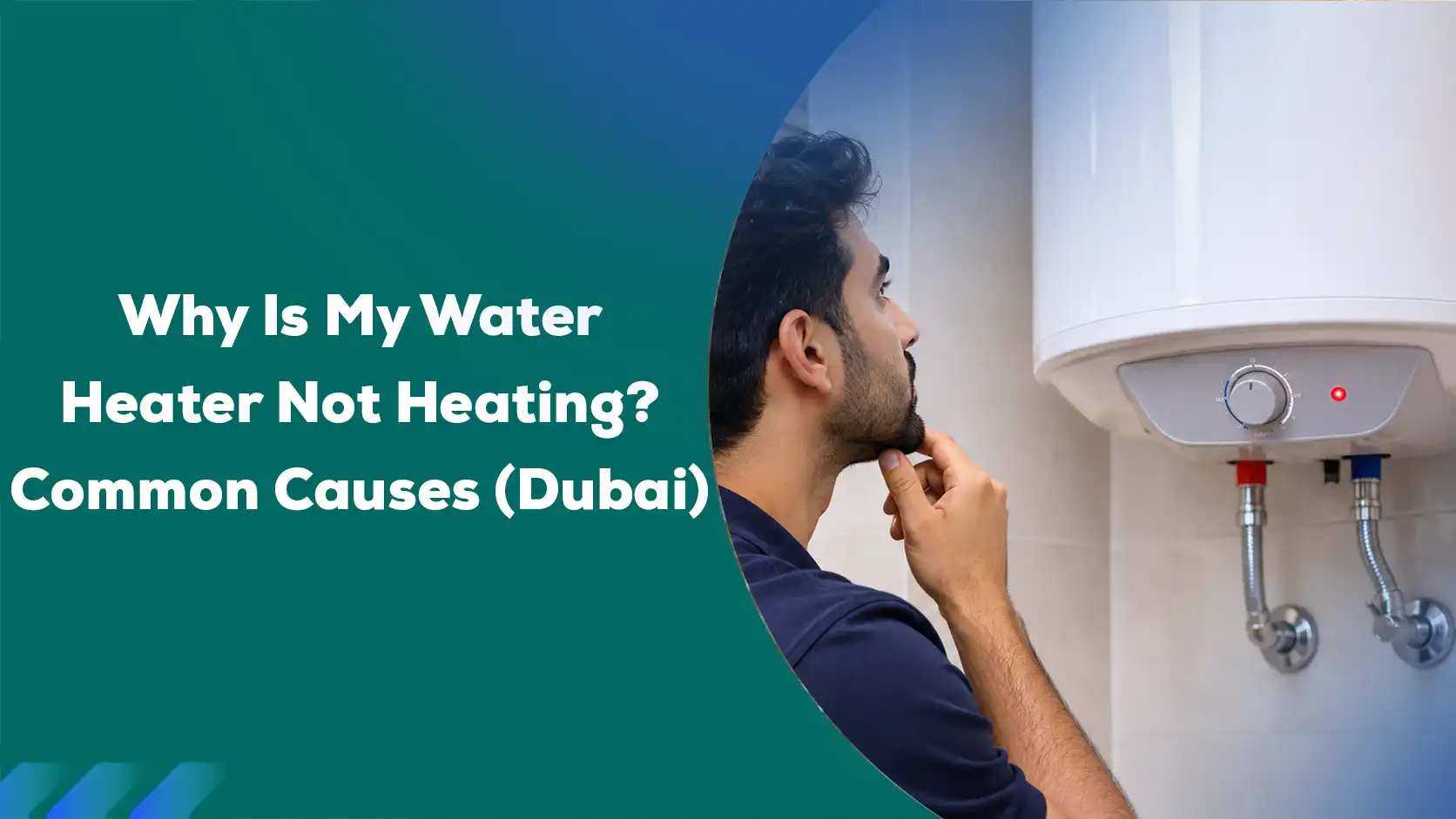
Why Is My Water Heater Not Heating? Common Causes (Dubai)
A water heater not working is usually traced to one of four faults: no power reaching the unit, a tripped thermostat or safety cutout, a burnt-out heating element, or a layer of scale on the element and tank floor. In Dubai homes, scale is the fault that gets missed most often, because tap water carries dissolved minerals that settle inside a heater over time.
This guide covers each fault, how electric and central systems differ, the checks you can do safely, and when replacing the unit makes more sense than repairing it. For the wider picture, our guide to everyday plumbing faults in Dubai homes is a useful companion read.

Key Takeaways
- Check power first. A tripped breaker or a switched-off isolator causes many no hot water calls.
- A heater that runs but stays lukewarm points to the thermostat, the safety cutout, or a failed element.
- Rumbling noises, slow heating, and hot water that runs out fast usually mean scale or sediment.
- Switch off at the isolator before touching anything, and never open the electrical cover unless you are qualified.
- A leaking tank body, repeated element failures, or a unit well past ten years old usually means replacement.
The Most Common Water Heater Faults
The faults below run from the simplest to the most involved, with the sign that points to each one.
1. Power is not reaching the heater
If the unit is cold and the indicator light is off, start here. A tripped miniature circuit breaker (MCB), a tripped residual current device (RCCB), or a switched-off wall isolator will all cut the supply. Power cuts and overloaded summer circuits are common triggers. If the breaker trips again straight after you reset it, stop and call a technician, because a repeat trip points to a real fault.
2. The thermostat or thermal cutout has failed
The thermostat tells the element when to switch on and off. If it reads the water temperature wrongly, the heater may stop early or never start. Most electric heaters also carry a thermal cutout, a safety device that trips when the water overheats and sometimes needs a manual reset. A heater that works for a few minutes and then goes cold often points to one of these two parts.
3. The heating element has burnt out
The element is the metal coil that warms the water. When it fails, the light may still glow and the unit may hum, yet the water stays cold. Larger tanks often use two elements. If only one fails you still get some hot water, but less of it and for a shorter time. A technician can test it with a multimeter and replace it.
4. Scale and sediment have built up
Minerals settle on the element and the tank floor. Scale acts like insulation, so the element takes longer to heat the same water and burns out sooner. Typical signs are a rumbling or popping noise, slow heating, cloudy hot water, and a higher DEWA bill. Flushing and descaling help early on. Heavy scale on an old element usually means replacing it.

5. Wiring, timer, or control faults
Older heaters, and central systems with timers, can fail at a loose connection, a damaged cable, or a faulty timer. Burn marks, a hot plug, or a burning smell mean the unit stays off until a qualified technician has checked it.
Why does hot water run out quickly?
The usual reasons are sediment taking up space in the tank, one of two elements not working, a thermostat set too low, or demand that is higher than the tank size. Winter makes this worse because colder incoming water takes longer to heat, so a unit that coped in summer can struggle in January. A sudden change suggests a failed element. A slow decline suggests scale.
Electric vs Central Water Heater Issues
An electric heater, often called a geyser, is a single tank serving one bathroom, a kitchen, or a small flat. A central system is a larger tank, boiler, heat pump, or solar unit with an electric backup that feeds a whole villa. The faults overlap, but the effects do not. When a geyser is not heating in Dubai, one bathroom loses hot water. When a central unit fails, every tap does.
Central systems also add parts that can go wrong, such as circulation pumps, timers, and long pipe runs that stretch the wait for hot water. If one bathroom has hot water and another does not, the heater is probably fine and the fault sits in a local mixer, valve, or pipe section. Weak hot flow without a temperature problem is a pressure issue, and our explainer on low water pressure in Dubai homes covers the usual causes.
| Feature | Electric water heater (geyser) | Central water heater |
|---|---|---|
| Typical setup | One tank for one bathroom or kitchen | Large tank, boiler, heat pump, or solar unit for the whole property |
| Common faults | Element, thermostat, cutout, scale | Backup element, timer, circulation pump, scale, pipe heat loss |
| Effect of a fault | One area loses hot water | Hot water is lost or weak across the property |
| Who should repair it | Licensed plumber or electrician | Licensed plumber, often with the system installer |
In a rented home, tell the landlord or property manager before arranging a repair, because the heater may be their fixture.
Comparison Table: Symptom, Cause, and Fix
Match what you see with the most likely cause. The rows cover the electric water heater problems technicians see most often.
| Symptom | Likely cause | Typical fix |
|---|---|---|
| No hot water, no indicator light | Tripped MCB or RCCB, isolator off, loose supply | Reset once. If it trips again, call a technician |
| Light on, water stays cold | Burnt element or failed thermostat | Test and replace the faulty part |
| Lukewarm water | Scale on the element, low thermostat setting, one element failed | Descale, adjust the setting, or replace the element |
| Heats, then goes cold | Thermal cutout tripping or thermostat fault | Technician tests and replaces the part |
| Hot water runs out fast | Sediment, one working element, undersized tank | Flush, replace the element, or size up |
| Rumbling or popping noise | Scale and sediment on the tank floor | Drain, flush, and descale |
| Water leaking from the tank body | Corroded tank or failed seal | Isolate power and water, then replace the unit |
| Drip at a pipe joint or valve | Loose connection or worn valve | Tighten or replace the part |

What You Can Check Yourself
These checks need no tools and keep you away from live parts. Work through them in order.
- Check the breaker. Reset the MCB or RCCB once. If it trips again, stop there.
- Check the isolator switch near the heater and its indicator light.
- Look at the thermostat setting. A dial turned right down, or moved by accident, is a common cause.
- Allow time to recover. A 50-litre tank with a 2 kW element needs roughly an hour or more to heat from cold.
- Test other taps to see whether the problem affects one fixture or the whole property.
- Look for leaks. Check under and around the tank for leaks, rust, or water stains, without touching electrical parts.
- Use the cutout reset carefully. Press the cutout reset button only if your manual shows one, only after switching off at the isolator, and only once.
Call a professional if the breaker trips repeatedly, you see water near electrical parts, you smell burning, the tank body leaks, or the next step would mean opening the cover. Never open an element cover while the unit is connected to power.
When to Replace vs Repair
Repair makes sense when one part has failed in an otherwise healthy tank. Replacement makes sense when the tank itself is failing. A licensed plumber can open the unit, test the parts, and tell you which side of that line you are on. As a rule of thumb, if the repair costs more than about half the price of a new unit, replacing is usually the better buy.
| Factor | Repair | Replace |
|---|---|---|
| Age | Under about eight years | Past about ten years |
| Fault | One part, such as an element, thermostat, or cutout | Leaking tank body or heavy internal corrosion |
| Repeat faults | First fault in a long time | Second or third fault in a year |
| Scale | Light and removable | Heavy, with the element encrusted |
| Running cost | Bills are steady | Bills rising while recovery slows |
Heavy scale can shorten a tank’s life. A leak from the tank shell is the clearest replacement signal, because the tank cannot be repaired safely.
FAQs
Why is my water heater not heating?
The most common causes are no power, a failed thermostat or cutout, a burnt-out element, or scale build-up. Check the breaker and isolator first, then the thermostat setting. If both are fine, a technician needs to test the element and thermostat.
How do I fix no hot water?
Check power, the thermostat setting, and whether the tank has had enough time to heat. If those are fine, the fault is inside the unit and needs a technician. Do not open the heater while it is connected to power.
Why does my hot water run out quickly?
Sediment, a failed second element, a low thermostat setting, or a tank that is too small for your household are the usual reasons. Flushing the tank and testing both elements shows which applies.
Is a leaking water heater dangerous?
Yes. Water near electrical parts creates a shock risk, and a leaking tank can damage floors and ceilings below. Switch off at the isolator, close the cold water inlet, and call a plumber.
How often should a water heater be serviced?
A yearly check suits most homes. The owner’s manual lists the exact tasks, and homes with heavy scale may need a flush more often.
Call a Dubai Plumber
If the basic checks do not bring the heat back, book a technician before a small fault becomes a failed tank. Hausfits’ plumbing team handles water heater repair in Dubai, including element and thermostat replacement, descaling, and full unit replacement. Property owners in Al Barsha can also reach local renovation and maintenance support for the same visit.